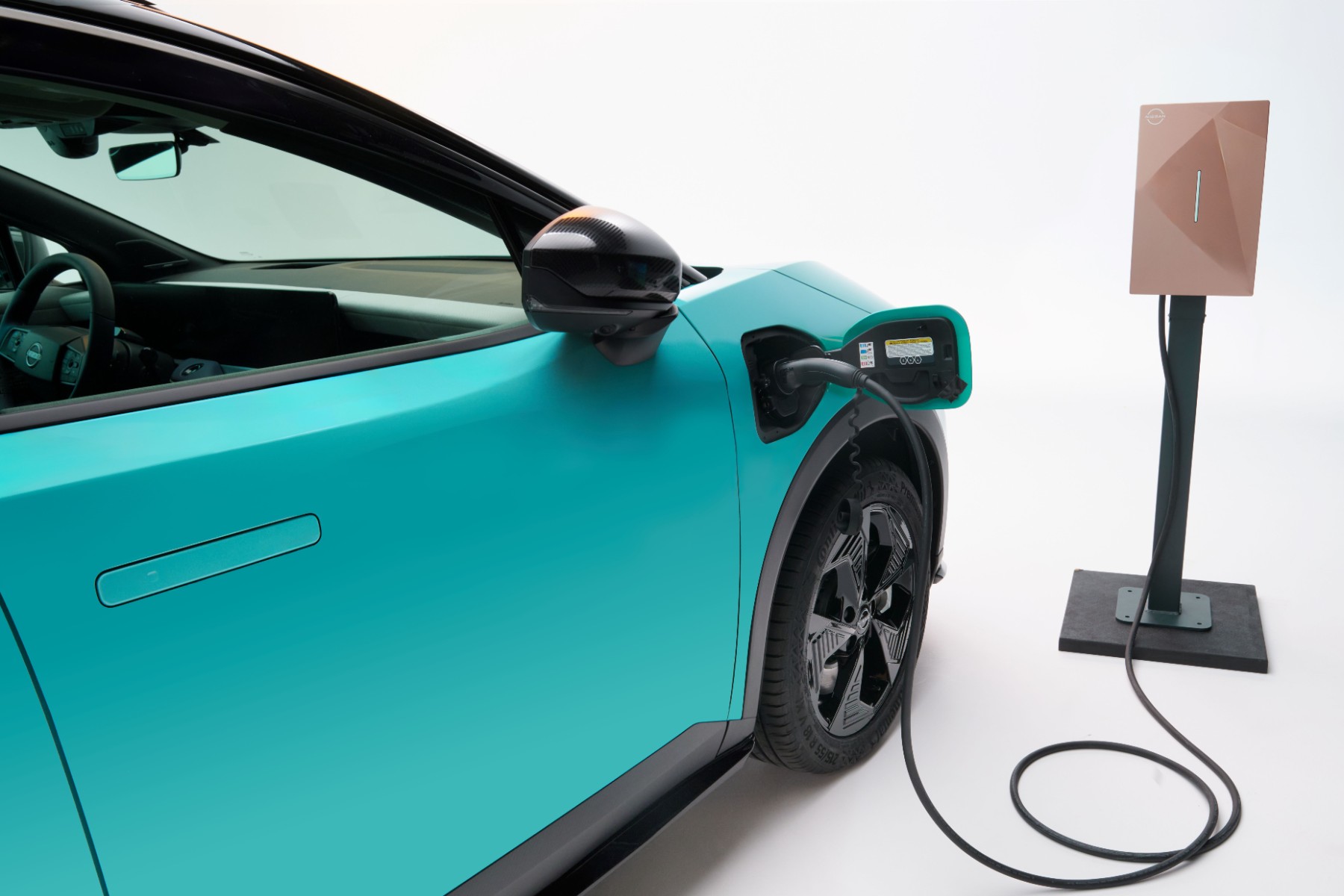
Nissan and Valeo signed a contract this week for bidirectional AC charging stations in Europe, with the system being showcased at the Power2Drive trade show in Munich. The deal is the concrete piece of a Nissan V2G roadmap the company first announced in 2024, and it's launching under the brand name Nissan Energy — starting in the UK later this year, with the new Nissan Leaf as the first compatible vehicle.
The headline is that V2G is finally real for European drivers. The interesting story underneath is why Nissan and Valeo chose AC.
What's actually being delivered
Under the agreement, Valeo will provide its Ineez-branded bidirectional charging station for Nissan customers across Europe. The unit is being shown at Power2Drive this week, and the rollout begins in the UK before expanding to other markets.
For Nissan, this is the on-the-ground delivery of the Nissan Energy service the company has been signaling since 2024. The offering combines a compatible EV (initially the new Nissan Leaf), a bidirectional wallbox (the Valeo Ineez), and a V2G tariff arrangement with a utility partner that lets the owner capture value from grid price arbitrage. The economics work like the Swedish pilots covered earlier this year: charge when power is cheap, discharge when it's expensive, and split the savings with the energy provider.
For Valeo, this is the first major OEM contract for its Ineez AC bidirectional platform, and a meaningful validation of the AC approach over the DC competition.
What "AC bidirectional" actually means, and why it matters
Most V2G coverage focuses on DC bidirectional charging — systems where the wallbox handles the bidirectional power conversion and the car just charges or discharges. That's the architecture BMW has chosen for the iX3 and Volkswagen Group (via its energy subsidiary Elli) has chosen for its V2G offerings.
Nissan and Valeo have taken the opposite path: AC bidirectional. The wallbox passes alternating current through to the car, and the vehicle's onboard charger handles the bidirectional inversion — converting AC to DC for charging the battery, and DC back to AC for discharging to the grid.
This is a meaningful design choice with real consequences:
- The wallbox is cheaper. Without its own power electronics, the AC station is closer in cost to a regular Level 2 EVSE. That's why AC V2G is the architecture that scales into home installations.
- The car is more expensive. A bidirectional onboard charger adds cost to every compatible vehicle. Nissan can absorb this because the Leaf is built on a mature platform with significant component commonality.
- The system is more deployable. AC infrastructure is what every home already has or can install cheaply. Pushing V2G through DC would have required new high-power wiring at every installation site.
For Nissan, the math is: pay the per-vehicle cost once, deploy cheap wallboxes in volume. For BMW and VW, the math is: keep per-vehicle cost low, push the cost into the wallbox and the utility infrastructure.
Both approaches work. Nissan's is the one that's easier to scale at the residential level, which is where most V2G will happen in the next five years.
Why the Leaf is the right first vehicle
The new Nissan Leaf is the first vehicle compatible with the system, and there's a reason for that beyond just timing.
The Leaf is Nissan's longest-running EV nameplate. It has the deepest installed base of any modern battery-electric vehicle — over 600,000 units sold globally, many of them still on the road. For Nissan, the existing Leaf owner base represents a population of customers who already understand EV ownership and are most likely to engage with an energy-services offering.
The new Leaf also has the technical capability to host the bidirectional onboard charger without architectural compromises. The vehicle's battery pack is sized for the use case (urban and suburban duty cycles, with charging at home), and the thermal management system can handle the additional cycling that V2G imposes.
The first vehicles to support Nissan Energy won't be the Ariya or the next-gen EVs. They'll be the new Leaf. That's a strategic signal: Nissan is using its most established EV to validate the energy-services business before extending it across the lineup.
What the two executives said
Two quotes worth flagging because they signal the strategic intent:
Soufiane El Khomri, Director of Nissan Energy Services, framed the deal as a redefinition of what a Nissan vehicle is for:
"This agreement with Valeo marks a concrete step in how Nissan is redefining its vehicles as energy assets, not just mobility products. By integrating Valeo's bidirectional charging technology into our V2X service offer, we are giving our customers in Europe the tools to actively manage their energy, reduce costs, and contribute to grid resilience."
Isabelle D'Ambrosio, Vice President of Smart Mobility at Valeo, framed it as a grid-stability play:
"This major contract with Nissan represents a decisive step in Valeo's ambition to shape the future of electric mobility. By combining Valeo's technological leadership in bidirectional charging with Nissan's vision for an integrated energy ecosystem, we are redefining the electric vehicle as a critical asset for the grid."
Both executives are using language — "energy asset," "critical asset for the grid" — that signals this is a long-term positioning move, not a one-off product launch. The bet is that EVs become grid assets by default, and the OEM that gets there first with a working residential V2G product captures the energy-services revenue stream that follows.
What this means for European drivers
For a UK household with a new Leaf and the Valeo Ineez wallbox installed, Nissan Energy becomes available later this year. The basic value proposition:
- Charge when grid electricity is cheap (overnight, off-peak).
- Discharge when grid electricity is expensive (early evening peak).
- Split the savings with Nissan's energy partner.
- Add grid services revenue when the car is parked and the battery has spare capacity.
The per-household savings depend entirely on the peak-to-off-peak spread in the local utility tariff — which, as the Swedish pilots demonstrate, can be meaningful where regulators have priced electricity honestly. In markets where residential tariffs are flat or only weakly time-of-use, the economics will be weaker until the tariff structure catches up.
What to watch over the next 12 months
- UK launch volumes. How many Leafs does Nissan actually sell with the V2G option bundled? That's the test of whether the offering is real or aspirational.
- Other European markets. The UK is first. Germany, France, the Nordics — the spread of Nissan Energy to other markets is the second-order question.
- Bidirectional Leaf pricing. The vehicle-side cost of the bidirectional onboard charger is the per-unit delta that matters most. If Nissan subsidizes it as part of the Energy service bundle, the take rate will be high. If it's an add-on option, the take rate will be lower.
- The competing standards. AC V2G (CHAdeMO 3.0 / ISO 15118-20) versus DC V2G (CCS2). The next year will tell us whether Nissan's AC bet pays off, or whether BMW and VW's DC bet wins the standard.
The verdict
For three years, V2G has been the EV industry's "we're going to do this soon" story. Nissan and Valeo's contract is the first European residential V2G deployment at OEM scale. The UK launches first, the new Leaf is the first compatible vehicle, and Valeo's Ineez is the wallbox.
The most important detail isn't the launch date. It's the architecture. By choosing AC bidirectional instead of DC, Nissan and Valeo have made a bet that residential V2G scales through cheap wallboxes and smart cars — not through expensive DC stations and dumb cars. Whether that bet is right will determine whether V2G becomes a real product category or stays a pilot program.
The next 12 months will tell us.
Source: electrive.com — Nissan and Valeo collaborate on bidirectional charging. By Florian Treiss, 23 June 2026. AutoWheeler analysis built on the source reporting; opinion and interpretation are our own.