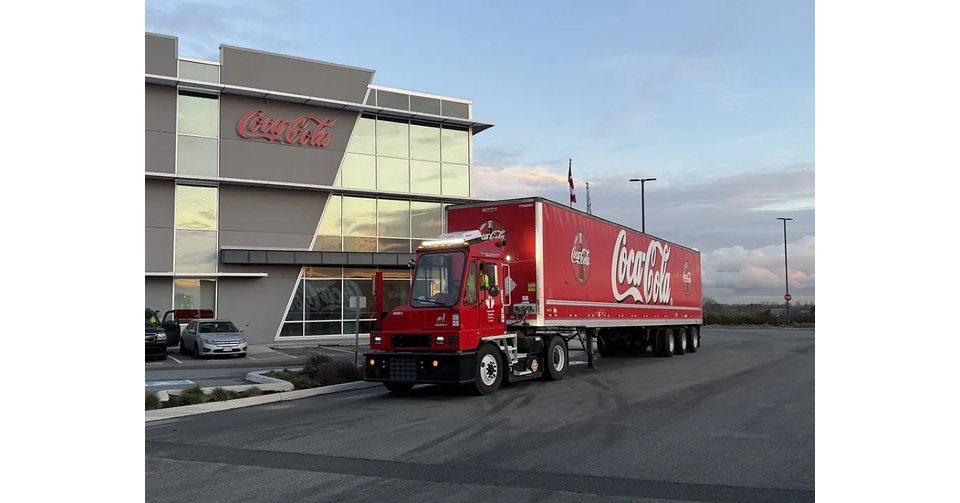
Orange EV announced today that it has deployed its 2,000th electric terminal truck, delivered to Coke Canada Bottling. The milestone is real. The headline number, however, is not the most useful number in the press release.
The number worth paying attention to is 97%. That's the average uptime Orange EV reports across its deployed fleet of more than 2,000 purpose-built electric yard trucks, running for more than 12 million key-on hours and 33 million miles of operation across over 370 fleets in 41 U.S. states, four Canadian provinces, and the Caribbean.
For anyone who's ever managed a logistics fleet, 97% uptime is the number that decides whether the technology is real or aspirational. Orange EV is reporting that the technology is real.
Why yard trucks are the EV use case nobody talks about
Yard trucks — the heavy-duty tractors that move trailers around distribution centers, ports, and intermodal hubs — are not glamorous. They don't make headlines. They don't appear in showroom reviews or get featured on automotive enthusiast channels.
They're the most validated application of heavy-duty EVs in North America.
The reason is structural. Yard trucks:
- Run short, predictable routes. A typical yard truck moves trailers a few hundred yards at a time, often under 25 mph. Range anxiety is a non-issue.
- Return to the same depot every shift. Charging infrastructure is built once, on-site, not negotiated with a utility.
- Operate in environments where diesel exhaust is a serious worker health problem. Drivers spend shifts breathing fumes in confined yards. Removing diesel from those yards is a workplace safety win, not just an emissions one.
- Run enough hours per shift that downtime is expensive. A yard truck that breaks down mid-shift blocks an entire dock door. The cost of a single broken-down unit runs into thousands of dollars per hour in stalled operations.
That last point is why the 97% uptime number matters. Yard trucks are punished for downtime harder than almost any other fleet vehicle. Orange EV is reporting that its electric units are matching or beating diesel uptime in the worst-possible operating environment for any failure.
What 2,000 trucks actually means
The deployment count is a manufacturing milestone. The press release frames it as "a broader industry tipping point," and Kurt Neutgens, Orange EV's co-founder, president, and CTO, says fleet operators have moved past the question of whether electric yard trucks can do the job and are now asking how quickly they can standardize around them.
That framing matters because it implies a shift in the buyer conversation. The first wave of electric yard truck buyers was making a sustainability bet — a willingness to pay a premium and accept some operational uncertainty in exchange for emissions reduction. The current wave, based on Orange EV's reporting, is making an operational bet. They're buying electric because uptime and total cost of ownership are now competitive, not because they need to hit an ESG target.
That's a different customer. Different customers buy more.
The Coke Canada Bottling context
Coke Canada Bottling is one of Canada's largest beverage manufacturers and distributors — a family-owned, independent business that operates across British Columbia and Quebec. The deployment expands its existing Orange EV fleet across both provinces.
In the release, Tony Chow, president of Coke Canada Bottling, frames the expansion as continuity with the company's existing environmental commitment. The interesting subtext is the timing: Coke Canada Bottling also named Orange EV one of its 2025 Supplier Partner Award winners at its annual Supplier Partner Forum. That's not a sustainability award. It's a procurement award — given to suppliers that delivered on cost, reliability, and operational fit.
Coke Canada Bottling's recognition of Orange EV on operational grounds, not sustainability grounds, is the kind of signal that moves fleet operators faster than any emissions claim.
What the other numbers say
Three more figures from the press release that deserve attention:
- 80 to 90 tons of CO₂ eliminated per truck annually vs. diesel yard trucks. Per-truck. Across a 2,000-truck fleet, the cumulative reduction is in the range of 160,000–180,000 tons of CO₂ per year.
- Two product lines: the e-TRIEVER®, deployed across warehouse and distribution operations, and the HUSK-e®, designed for intensive port and heavy-duty applications. The product split is meaningful because it means Orange EV isn't a single-purpose vendor — it covers the two heaviest yard truck duty cycles.
- Four Canadian provinces and Caribbean deployments. This isn't just a US story. Cold-weather operation in Quebec and intermodal operation in the Caribbean are both hard duty cycles that have historically been unfriendly to EV adoption. Orange EV is reporting success in both.
What to watch over the next 12 months
- Whether the 2,000th truck unit economics survive fleet standardization. If Coke Canada Bottling and similar fleet operators move from "let's try some electric units" to "let's convert the whole yard," the unit-economics question gets answered at scale. The press release language ("asking how quickly they can standardize") suggests that conversion is coming.
- Whether competitor uptime data shows up. If Orange EV's 97% uptime is the high-water mark, the next 18 months will tell us whether other electric yard truck manufacturers can match it. If they can't, Orange EV has a defensible lead.
- Whether ports adopt at scale. Ports are the most emissions-intensive yard-truck operating environment and the one where diesel health impacts on workers are most acute. A port fleet conversion announcement would be the single biggest signal that yard-truck electrification is durable.
The verdict
A 2,000-truck milestone is a manufacturing headline. A 97% uptime figure across 12 million hours of operation is an operational fact. The two together tell a story that's bigger than either number alone: heavy-duty electric fleet vehicles have moved from sustainability purchase to operational purchase, and the segment that proves it first is one most automotive coverage has been ignoring.
Yard trucks aren't going to set anyone's pulse racing. But for the people running distribution centers, ports, and intermodal hubs, they're the part of the EV story that actually pencils out today — and that has been true for long enough that the 2,000th truck is a routine milestone, not a breakthrough.
Source: PR Newswire — Orange EV Deploys its 2,000th Electric Terminal Truck to Coke Canada Bottling. Press release distributed by Orange EV. AutoWheeler analysis built on the source press release; opinion and interpretation are our own.