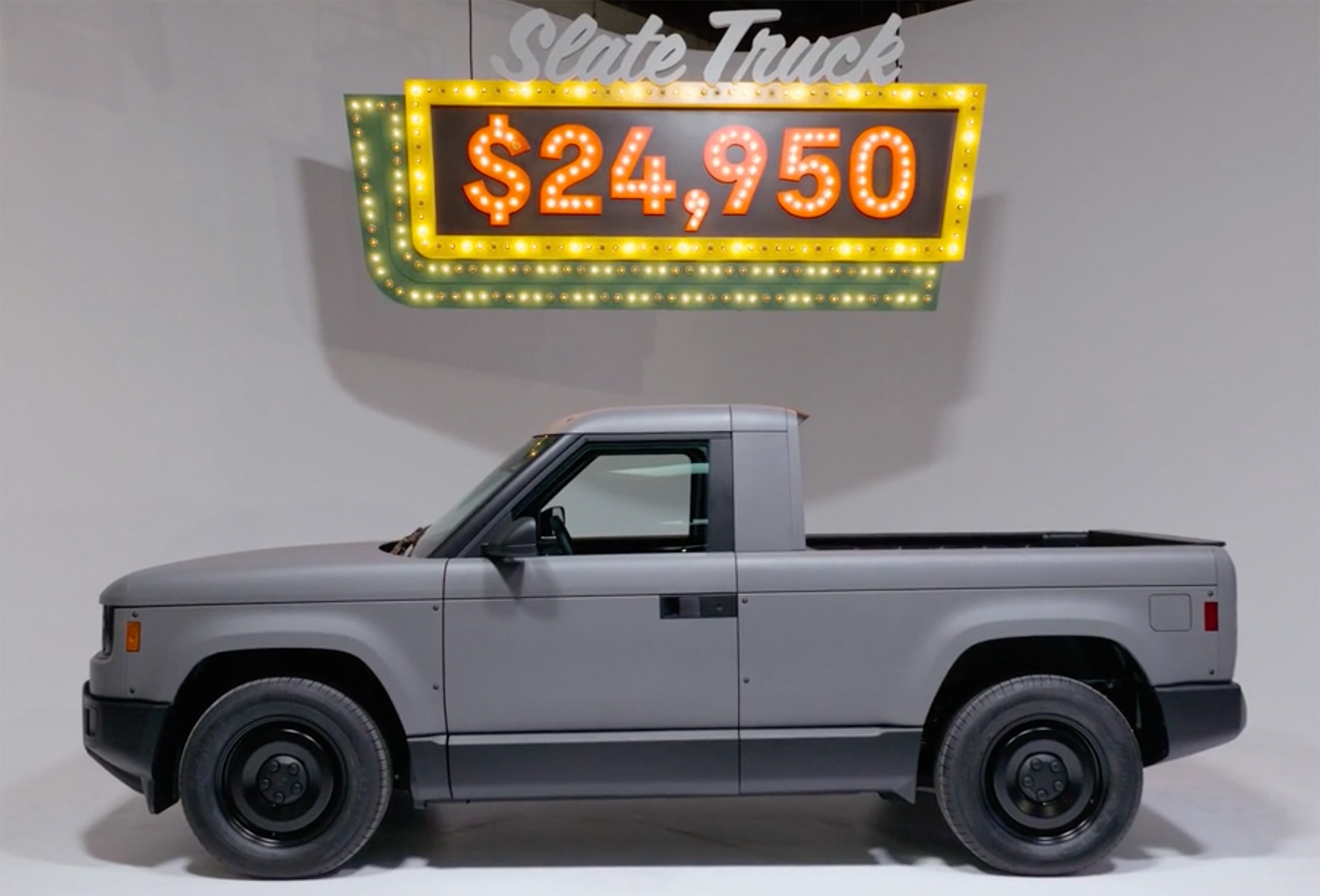
Slate Auto confirmed pricing and specifications this week at a media event in Southern California, ending a 14-month stretch of "is this thing real?" speculation. The headline number is the one that's been promised since the company emerged from stealth: $24,950 for the base Blank Slate pickup. The asterisk on that price is worth understanding before anyone writes "Slate undercuts every EV in America."
It does. Just not quite as cleanly as the headline suggests.
What was actually confirmed
Three body styles are available at launch, all built on the same platform:
- Blank Slate pickup — two-door, standard-cab pickup. Base price $24,950. Five-foot bed. This is the truck in every "Slate" headline.
- Squareback wagon — a panel kit that removes the cab back, remounts it as a tailgate, adds a second-row seat. The result is a two-door wagon with a square roofline — a body style largely absent from the US market for decades. $29,950.
- Fastback SUV — a more sloping variant of the Squareback idea, visually similar to the old International Scout Sportop shell. $31,950.
Every Slate ships from the factory as a grey pickup. The two SUV body styles will be available as flat-pack kits for DIY conversion at launch — the company previously signaled this and confirmed it again at the event. Autopian has suggested further alternatives (extended cab back, convertible pickup), and the company is signaling openness.
More than 180,000 reservation holders (each with a $50 deposit placed since April 2025) can now configure their trucks online for an additional $250 deposit. Slate confirmed first customer deliveries will happen in Q4 2026.
The asterisk on $24,950
The $24,950 figure is the MSRP. It does not include the destination and delivery fee that every manufacturer adds on top of MSRP. Those fees run from $1,150 to over $3,000 in the current market. Slate told Charged it will reveal its D&D fee closer to first delivery.
If Slate matches the cheapest D&D on the market today ($1,150), the actual out-the-door price for a base Blank Slate (before taxes and registration) becomes $26,100. That's still meaningfully cheaper than any new EV sold in America today — but it's not the "$25K EV" headline.
Whether Slate can get the D&D fee down to $995, which would let them credibly advertise "from $25,945," is one of the more interesting operational questions for a startup launching its first vehicle.
What the truck actually delivers on
The powertrain numbers are honest, not aspirational:
- Rear-mounted motor: 135 kW (181 hp), 264 Nm (195 lb-ft)
- 0–60 mph: 8.0 seconds — respectable, not fast
- Battery: 65 kWh LFP (63 kWh usable), Gotion cells, packs assembled in Illinois, final assembly in Warsaw, Indiana
- Range: 205 miles (single configuration; the previously announced 150-mile and 240-mile dual-pack SK-On NMCA plan was dropped)
- Charging: NACS port, 11 kW AC onboard (20→100% in 4 hours), 120 kW DC fast (20→80% in 30 minutes)
LFP chemistry has one important practical consequence: it can be charged to 100% routinely without accelerated degradation, which is not true of NMCA cells (typically recommended to charge only to 80%). For a truck aimed at buyers who want to use it without thinking about battery management, that's a meaningful design choice in Slate's favor.
What the truck can actually do
- Towing: 2,000 lbs — riding mowers, motorcycles, jet skis, small ATVs. Not an Airstream.
- Payload: 1,550 lbs
- Curb weight: 4,050 lbs (pickup), 4,335 lbs (SUV variants)
- Bed: 5 ft (60.5 in), or 80.7 in with the tailgate down
- Frunk: 7 cu ft
- SUV cargo: 34 cu ft behind the rear seat, 58.4 cu ft with the second row folded
- Wheels: 17-inch steel
These numbers are honest small-truck numbers. The Slate is built to compete with the Honda Ridgeline of the 2000s in terms of capability, not the F-150 Lightning.
The Slate Marketplace is the actual business model
The truck is the loss-leader. The marketplace is the business.
Slate confirmed at the event that the company expects the majority of buyers to customize their vehicles through the Slate Marketplace, launching with more than 200 accessories — 80% of them priced under $500. Items include:
- Cupholders, consoles, mobile-phone mounts
- Power windows (not standard)
- Stereos (not standard — the base truck has no radio)
- Zip-on seat covers, roof racks, light covers
- Full-vehicle wraps, starting under $500, in more than 100 colors
This is the part of the Slate story most coverage misses. The $24,950 truck ships as the truck the marketing says it is — hand-crank windows, no radio, no paint, steel wheels. Every comfort or aesthetic feature is an aftermarket accessory, sold through Slate's own marketplace, with the company capturing margin on each.
That's how a $25,000 truck becomes profitable. It's also why the actual average transaction price for a configured Slate is going to be meaningfully higher than $24,950 — closer to $30K, possibly more for buyers who spec into the SUV body kits and a wrap.
What this means for the US EV market
The US hasn't seen a sub-$25,000 new EV since the Chevrolet Bolt EV briefly dipped below that line in 2022 with significant incentives. The federal EV tax credit's expiration at the end of 2025 removed the structural mechanism that made sub-$25K EVs viable for most US automakers. Slate's $24,950 price is the first post-credit entry into that bracket for a brand-new American EV.
That's worth saying out loud, because most coverage frames Slate as a curiosity rather than a market event. Ivan Drury, Director of Insights at Edmunds, framed the launch correctly at the event: "Slate is making a $25,000 bet that drivers still want something simple. Our data show the market quietly walked away from that price years ago, so this is a real test of how much affordability still matters to today's buyers."
If buyers show up, the implication for Ford, GM, and Stellantis is significant. None of them currently build a sub-$30K EV for the US market. None of them have announced plans to. Slate's Q4 2026 deliveries will tell us whether the segment is dormant because buyers don't want it, or because the existing manufacturers decided it wasn't profitable enough to bother.
What to watch over the next 12 months
- First-quarter delivery volumes. 180,000+ reservations is real demand if it's real conversions. If Q4 2026 deliveries land in the high four figures, the thesis holds. If they're in the low three, the production ramp is the story.
- The actual D&D fee. If it's under $1,000, the "$25K EV" marketing is honest. If it's $1,500+, the asterisk becomes the story.
- The marketplace take-rate. Slate's per-truck profitability depends on accessory attach rates. Watch whether buyers spec the truck they ordered or convert it into something else entirely.
- Ford's response. If Slate sells, Ford has the most to lose — the Maverick is the closest existing competitor and starts ~$5,000 higher.
The verdict
Slate's $24,950 EV pickup is the most interesting American car launch of 2026, and the most under-reported one. The headline price is honest, the truck is real, the production timeline is concrete, and 180,000 people have already voted with $50 deposits that they want it.
The asterisk on D&D fees is real but small. The bigger asterisk is the one nobody's writing about: Slate's actual business model is the marketplace, not the truck. The vehicle is the platform. The accessories are the margin.
That's a different kind of car company than the industry has seen in a long time. Whether it's also a successful kind is the question the next 12 months will answer.
Source: Charged EVs — 2027 Slate EV pickup: $25K+ prices, delivery by end of year, 205-mile range and more. First-person reporting by John Voelcker from the Slate media event. AutoWheeler analysis built on the source reporting; opinion and interpretation are our own.